Deepdive: Our Reporting Journey.
RegReportify is built on the principle of transforming regulatory reporting from a cumbersome, error-prone process into a streamlined, strategic asset. Founded by experts with hands-on experience at top Dutch banks, our platform combines deep regulatory knowledge with advanced data and system flow expertise to deliver a comprehensive solution.
The Reporting Journey
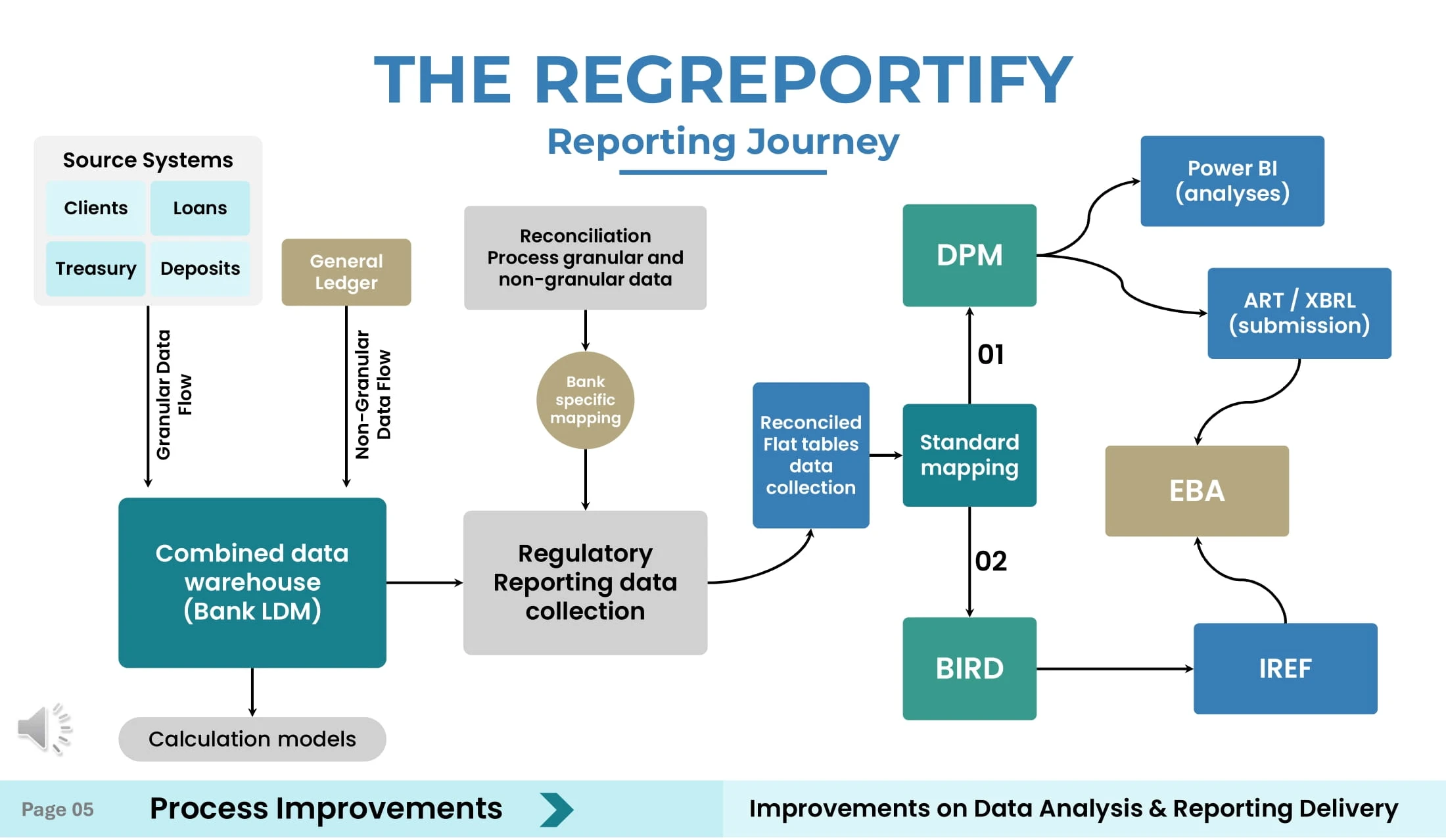
Our process begins by integrating data from all source systems—clients, loans, treasury, deposits, and the general ledger—into a combined data warehouse based on a bank-specific Logical Data Model (LDM). This warehouse serves as the single source of truth, supporting both granular and non-granular data flows with realtime Power-BI analysis possibilities.
- Granular Data Flow: Transaction-level data is processed for detailed reporting, based on various sources in the bank.
- Non-Granular Data Flow: General ledger data processed on aggregated level from the accounting system
- Reconciliation: Granular and non-granular data are matched to identify and resolve discrepancies, such as timing gaps or accounting misalignments.
- Bank Specific Mapping: Apply bank-specific mapping (to be developed with Regreportify expertise) to prepare and enrich data for standardized Data Point Model (DPM) and Bird Mapping.
- Standard Mapping: Data is mapped to EBA templates and BIRD taxonomies.
- Output: Flat tables are generated for current DPM reporting, with outputs ready for IReF and XBRL/ART submissions. Power BI dashboards provide real-time analysis possibilities.
Reconciliation Process
Our six-step reconciliation process ensures every report is accurate and audit-ready, addressing common discrepancies outlined in the “Why Discrepancies Happen” section (e.g., data aggregation errors, system issues, human errors).
- Data Extraction & Comparison: Pull data from source systems and the general ledger, identifying mismatches like missing entries or balance differences.
- Identify & Categorize Differences: Analyze discrepancies (e.g., timing gaps, system errors) and categorize for efficient resolution.
- Mitigation Actions: Align GL and source systems with adjustments, using dummy data or adding missing records as needed.
- Final Reconciliation & Reporting: Complete checks post-mitigation, delivering a reconciled reporting package with notes on residual issues.
- Continuous Improvement: Log discrepancies, analyze trends, and apply fixes for future cycles.
- Documentation & Feedback: Conduct stakeholder reviews, maintaining audit-ready documentation.
Standard Mapping
RegReportify’s mapping engine applies multi-dimensional mappings to align bank-specific data with regulatory taxonomies. For example, a bank’s loan products (e.g., Home Loan, Mortgage) are mapped to reporting types (e.g., Consumer Loan) and stages, ensuring compliance with DPM, BIRD, and IReF requirements. This granular approach provides full traceability and reduces reporting errors.